Whatsapp templates category guidelines
Learn how WhatsApp Business API message template categories work and how to use marketing, utility, and authentication templates correctly for fast approval.
Written by
Super Admin
Message Templates Category Guidelines for WhatsApp Business API
WhatsApp Business API allows businesses to send proactive messages to users through message templates. To ensure user trust and platform safety, Meta classifies every template into specific categories. Understanding these categories is critical for template approval, message delivery, and maintaining a high quality rating.
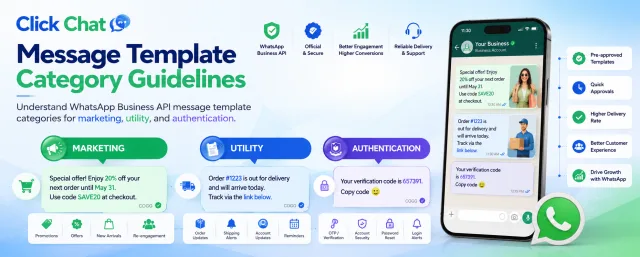
As per the latest guidelines effective July 1, 2025, message templates fall into three main categories: Marketing, Utility, and Authentication .
---
1. Marketing Message Templates
Marketing templates are used to promote, inform, or re-engage customers. These templates help businesses generate awareness, drive sales, and build relationships.
Common use cases:
New product or service announcements
Offers, discounts, and promotions
Cart abandonment reminders
Subscription renewals
Birthday or anniversary greetings
App download or feature promotion
If a message contains any promotional or persuasive content, it is classified as Marketing, even if it also includes utility information. Mixed content templates always fall under this category .
Important rules:
Messages can only be sent to opt-in users
Vague messages like “Congratulations!” are treated as marketing
Re-engagement messages are marketing, even if requested earlier
Marketing templates are charged at marketing conversation rates.
---
2. Utility Message Templates
Utility templates are non-promotional and meant to deliver essential or requested information related to a user’s transaction, account, or safety.
Common use cases:
Order confirmation, shipping, cancellation, refund updates
Payment reminders
Account alerts and balance updates
Feedback requests linked to a specific order
Opt-in or opt-out confirmation
Support follow-ups requested by the user
Utility templates must not include:
Offers or discounts
Upselling or cross-selling
Persuasive or sales language
Even a small promotional line can cause rejection or reclassification as marketing .
Special utility cases:
Some utility templates are considered essential or critical, such as:
Fraud alerts
Product recalls
System outages
Health or public safety messages
Legal or regulatory notifications
These must remain strictly informational.
---
3. Authentication Message Templates
Authentication templates are the most restricted category. They are used only for identity verification through one-time passcodes (OTP).
Allowed use cases:
New account creation
Login verification
Account recovery
Transaction confirmation
Strict requirements:
Only WhatsApp’s preset authentication templates can be used
OTP button (copy code or one-tap) is mandatory
No URLs, images, emojis, or promotional text allowed
OTP parameters have length restrictions
Only authentication templates can send OTPs
Authentication templates are supported on Cloud API and follow separate pricing rules .
---
Why Correct Categorization Matters
Choosing the wrong template category can lead to:
Template rejection
Higher messaging costs
Quality rating drop
Messaging limits reduction
Correct categorization ensures:
Faster template approval
Better message delivery
Lower block and report rates
Long-term account stability
---
Final Summary
WhatsApp Business API template categories are designed to protect users and ensure meaningful communication.
Marketing: Promotion, offers, re-engagement, relationship building
Utility: Transactional, account-related, essential updates
Authentication: OTP and identity verification only
Businesses should always:
Send templates only to opted-in users
Avoid mixing promotional content in utility templates
Use authentication templates strictly for verification
Following these guidelines helps businesses scale safely and maintain high-quality WhatsApp communication.